Know If Investors Read Your Deck
Pitch deck tracking is sending your deck as a link instead of an attachment, so each investor's open is recorded. You see who opened it, how far they got and how often they came back. An attachment tells you nothing, so a founder is left guessing whether silence means no, or means the deck was never opened.
The tools below differ in what they track, what that costs and how much of an investor room they build around the deck. Most are made for a data room. Loop is made for sending one file and seeing how it is read.
Loop
Loop is a Mac app that turns a file into your own branded link, and follows every open. Export your deck as a PDF and send the link. When an investor opens it, you see who they are, how far they got and how many times they came back, and a notification appears on your Mac the first time a reader opens it. Investors can also highlight a figure or leave a note on a slide, and ask a question at the end, with no account. The recording below shows an investor's side.
A real recording of Loop's reader page. Press play, or jump to a step.
The same steps in words:
- Open. The investor opens your link on a page with your logo, name and colours.
- Turn Pages. They move through the slides, and Loop counts the time on each.
- Slide 4. They stop on the revenue slide.
- Highlight. They pick the highlighter and mark the $1.8M ARR figure.
- Note. They write "What's churn behind this?" on the slide and press Leave Note.
You see the note in Loop, with a notification on your Mac. This is the view you get on your side.
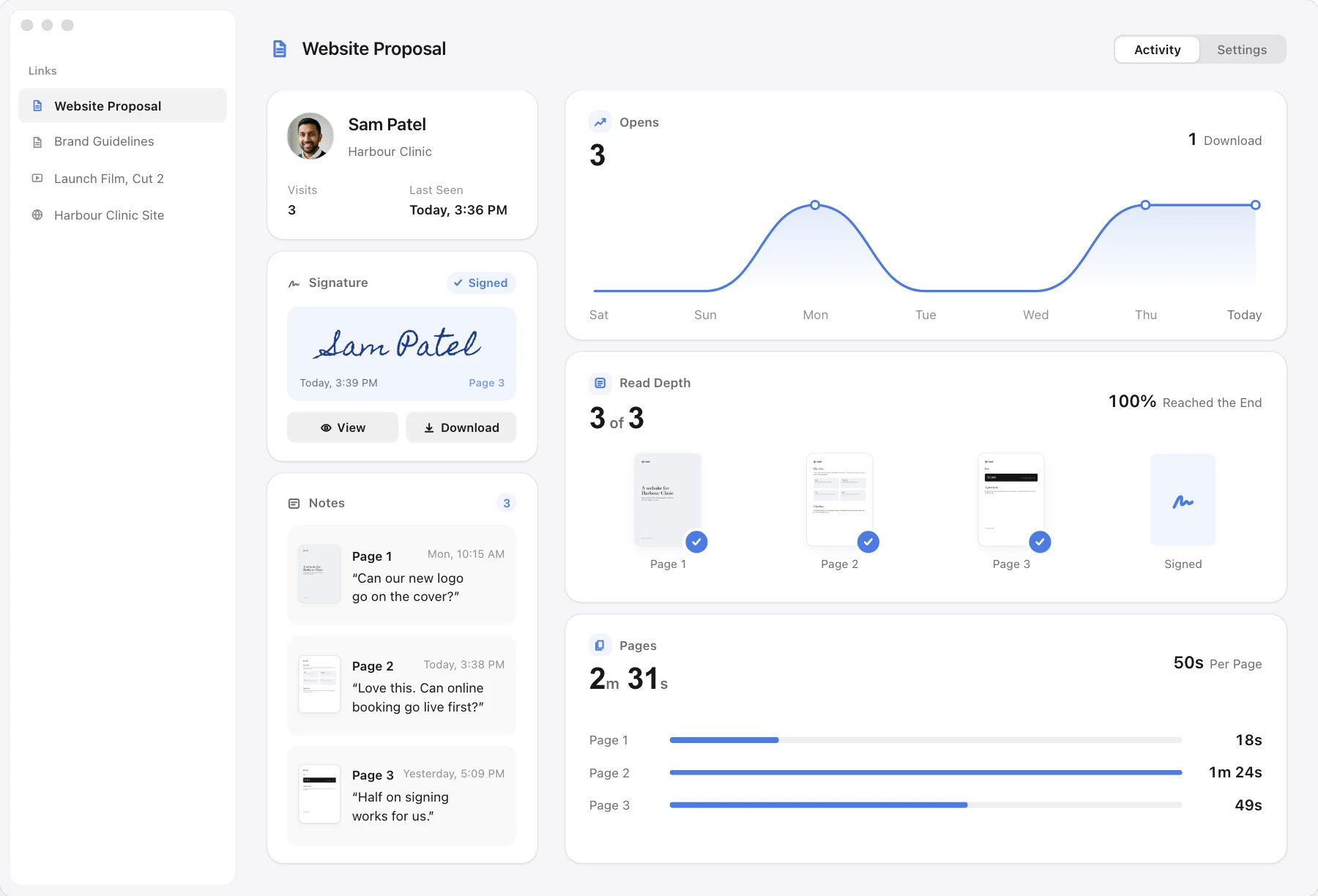
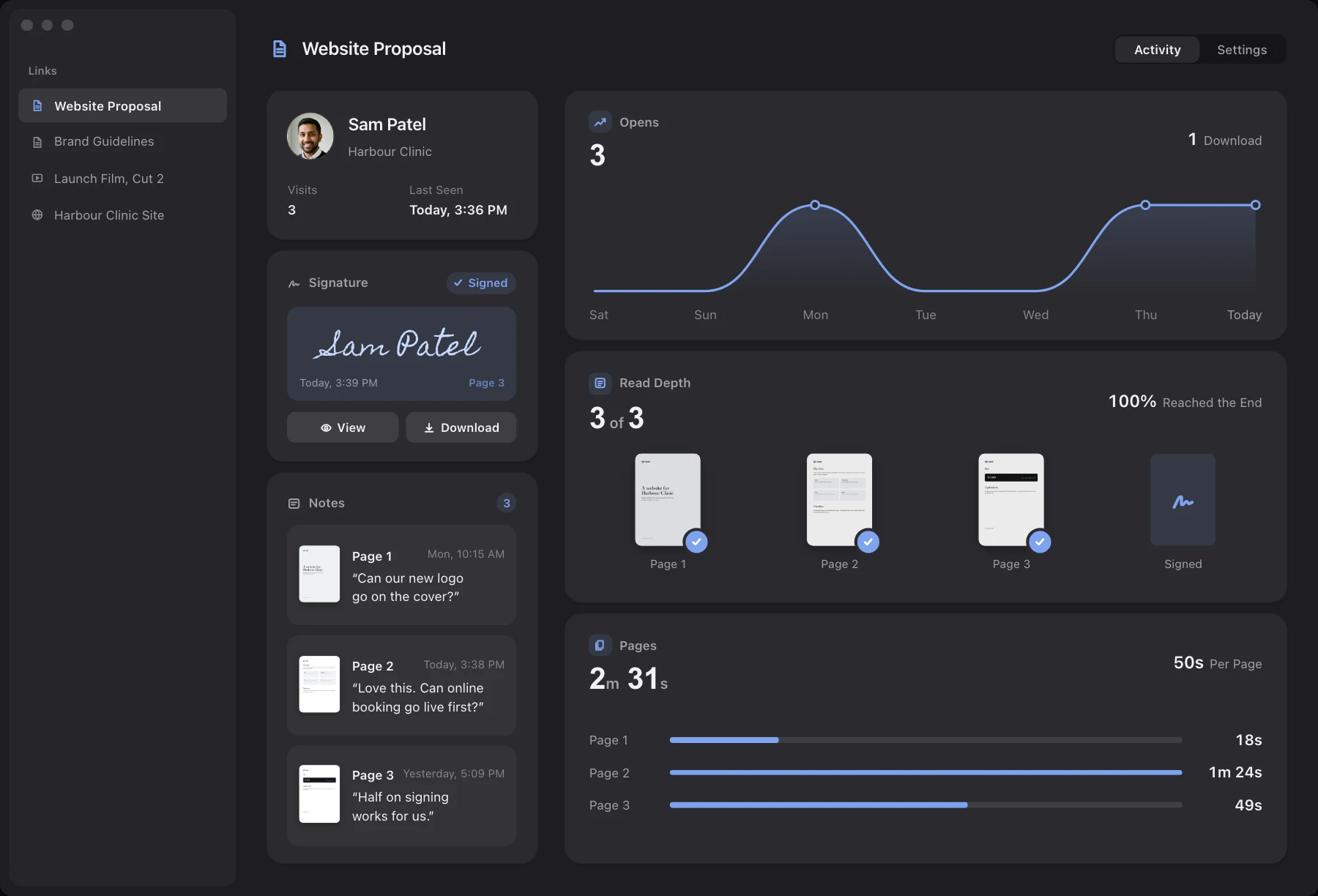
Each person who opens the link gets a row with their name or email, company, town, device, the furthest slide they reached ("3 of 8"), when they were last seen and how many visits. The time on each slide is an average across everyone who read it, so it shows which slides hold readers. It does not show one investor's seconds on one slide.
Highlights
- Your own branded link. Your logo, colours and typeface on every page an investor opens.
- A notification on first open. Loop tells you the first time a reader opens it, on your Mac while Loop is running.
- How far each investor got. The furthest slide reached, visits and last seen for each person.
- Change the deck, keep the link. Replace the file and the same link opens the new version.
- No account for the investor. They open the link in any browser.
- Pay once. $49 for one person, yours forever, with a 14-day free trial.
Your own branded link, with notes on the exact second. $49 once.
Options
The tools below differ in what they track and what that costs. Several of them are data rooms with folders, groups and permissions, which Loop is not.
| Tool | Tracking | Cost, one person |
|---|---|---|
| Loop | Page time, opens, repeats | $49 once |
| DocSend | Page time, by person | $120 to $360 a year |
| Papermark | Page time, by person | Free, or $348 a year |
| Visible | Per-slide time, Core plan | $1,548 a year |
| Google Drive | Signed-in viewers only | $84 a year |
US dollars for one person, billed yearly, before tax, on the plan that has the tracking, read from each vendor's own pages on 23 October 2026. Papermark shows euros until the dollar button is pressed. DocSend's page serves two price lists: one has Standard at $30 a month, and the other has a $10 Personal plan and Standard at $45. The range covers both lists. Visible's Base plan is $708 a year and records opens only. Google's figure is its US one-year price.
DocSend
DocSend is the tool most founders know. Its how it works page says it shows views and time spent on each page, by individual, and its pricing page lists read and forward notifications. The page serves two price lists. One has Standard at $30 a user a month billed yearly, $360 a year. The other has a $10 Personal plan, $120 a year, and Standard at $45. There is no free plan. Our Loop vs DocSend page goes further.
Papermark
Papermark is open-source document sharing. Its pricing page lists page-by-page analytics on every plan, including a free plan with 1 member, 50 links and 50 documents. Pro is $29 a month billed yearly, $348 a year. Our Loop vs Papermark page goes further.
Visible
Visible is an investor-update platform that also shares decks. Its pricing page has a free Starter plan with deck open analytics. Per-slide analytics start on Core, at $129 a month billed yearly, $1,548 a year. Base is $59 a month, $708 a year, with open analytics only.
Google Drive
Google Drive's view history shows only people who are signed in, and shows nothing on files that are not owned by a work or school account (Google's help page). An investor who opens an "anyone with the link" file without signing in is not tracked. Google Workspace Business Starter is $7 a user a month on a one-year commitment, $84 a year (Google's pricing page), and a free account comes with 15 GB.
Limits
Loop is built for sending one deck and seeing how it is read. It is not a data room or an investor pipeline, and these gaps matter for a fundraise:
- No data room. A folder link is protected as one unit, with no groups, Q&A or reader audit log. You can give each investor their own link, and each link has Allowed and Blocked lists by email or company address.
- No investor list. Loop has no pipeline, statuses or notes for each investor.
- No per-investor slide time. The Activity view shows each person's furthest slide and visits, and an average time for each slide.
- A typed email is not checked. If you ask for an email before viewing, Loop checks only that it looks like one, so an investor can type any address.
- No forward detection. A forwarded link opens as a new reader. With Ask for Email on, the new person types their own address and appears as a new row. Without it they show as "No email given".
- No NDA step before viewing. Loop can take a typed-name signature on a PDF, which is a simple electronic signature.
- Notifications are on your Mac only, and Loop must be running.
- Mac only on your side. Investors open the link on any device.
If you need folders, permissions and an audit log for diligence, use DocSend or Papermark. If you send one deck and want your own name on the link, use Loop.
Cost
For one person for one year, Loop is $49, paid once. DocSend is $120 to $360, Papermark is free or $348 a year, Visible is $1,548 on the plan with per-slide time, and Google Drive is $84 without tracking for readers who are not signed in. The yearly prices come back every year, while Loop has no renewal.
Loop includes a 14-day free trial that starts on first run, and Loop asks for no payment to begin it. During the trial a small "Shared with Loop" badge shows on the pages your clients see, and it goes with a licence. Your files are stored in your own Cloudflare account, and Cloudflare may ask for a card when you switch storage on.
Sending Your Deck
Five habits make any tracked deck more useful, whichever tool you use.
- Send a PDF. Export from Keynote, PowerPoint or Pages so every slide counts as a page. Without Keynote installed, Loop shows only the first slide of a Keynote file.
- Send one link per investor. Duplicate the link for each person, so the opens and the slide averages belong to one investor.
- Ask for an email when you need to know who opened it. Without it, a reader shows as "No email given".
- Turn off Download if you want the deck read in the browser. It hides the button and is not copy protection.
- Replace the file, keep the link. When you update the deck, the same link opens the new version.